

Understanding hearing loss in the classroom
Hearing loss is an access issue, not a reflection of cognitive ability or intellect. At Sound Wave Academy, we support Australian educators to recognise barriers early, debunk common misconceptions, and implement practical adjustments that allow deaf and hard of hearing students to flourish.
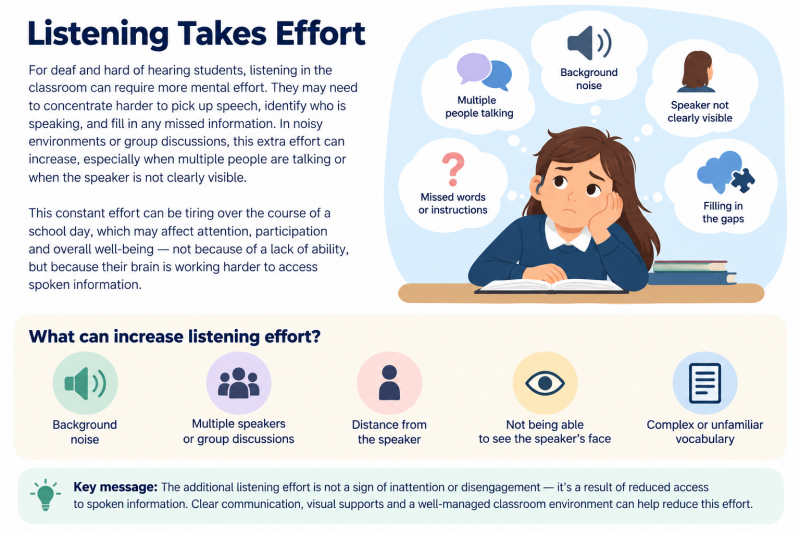
Deaf and hard of hearing students experience communication and learning environments in different ways. Hearing levels, communication preferences, hearing technology and individual support needs can vary considerably between students. Understanding these differences can help teachers recognise potential barriers and make informed adjustments that improve access, participation and inclusion.
Research shows that deaf and hard of hearing students can experience increased listening effort in classroom environments, particularly when background noise, multiple speakers and demanding listening conditions are present (Mealings et al., 2024; Nelson et al., 2020).
Access to sound versus cognitive capability
Deafness or hearing loss should not be mistaken for reduced intellectual or academic ability. In mainstream classrooms, a significant barrier for deaf and hard of hearing students can be access to spoken information. When a student misses a verbal instruction, question, or classroom discussion, this should not automatically be interpreted as disengagement, inattention, or a lack of understanding. Providing clear visual information, good lines of sight, and accessible communication can reduce these barriers and give students greater opportunities to participate fully in classroom learning.
Hearing Access ≠ Learning Ability
Deafness or hearing loss should not be mistaken for reduced intellectual or academic ability. In mainstream classrooms, a significant barrier for deaf and hard of hearing students can be access to spoken information. When a student misses a verbal instruction, question, or classroom discussion, this should not automatically be interpreted as disengagement, inattention, or a lack of understanding. Providing clear visual information, good lines of sight, and accessible communication can reduce these barriers and give students greater opportunities to participate fully in classroom learning.
Hearing Technology: Helpful, But Not Perfect
Myth: “They have hearing aids/cochlear implants, so they can hear everything.”
Reality: Technology can improve access to sound and speech, but background noise, distance, acoustics and competing speakers can still create barriers.
Hearing technology can significantly improve access to sound and speech, but it does not remove every communication barrier. Background noise, distance from the speaker and classroom listening conditions can still make spoken information difficult to access (Hearing Australia, 2023)
Learning Happens Beyond the Teacher
Not all learning happens through direct instruction. Students also gain information by overhearing questions, classroom conversations, quick teacher comments, peer discussions, jokes, and informal interactions. Deaf and hard of hearing students may have reduced access to some of this incidental information, particularly in noisy environments or when multiple people are speaking.
These communication barriers can also extend beyond academic learning into group work, playground conversations, friendships, and other social interactions. Teachers can support participation by making important information explicit, encouraging clear turn-taking, identifying speakers during discussions, and creating opportunities for students to engage with their peers in accessible ways.
Access to Literacy & Numeracy
Literacy
Access to spoken language can play an important role in developing vocabulary, phonological awareness and literacy skills. Deaf and hard of hearing students may miss parts of verbal explanations, classroom discussions or new vocabulary when information is primarily presented through speech. Visual supports, written key terms and explicit explanations can help make literacy learning more accessible.
Research into literacy instruction for deaf and hard of hearing students highlights the importance of providing accessible language and making classroom content and thinking visible. Dostal et al. (2017) emphasise that deaf and hard of hearing students are a diverse group of learners, meaning literacy instruction should respond to individual language, communication and learning needs rather than assuming one approach will suit every student.
Numeracy
Hearing loss does not mean reduced mathematical ability. Barriers can occur when mathematical vocabulary, multi-step instructions and problem-solving explanations are delivered primarily through speech. Providing written steps, visual examples and key mathematical terminology can help students access the same concepts without relying solely on verbal information.
Differences in access should not be mistaken for differences in ability. The goal is to make classroom information accessible so students have the opportunity to demonstrate what they know.
Different Stages, Different Barriers
Communication barriers can change as students progress through school. During the primary years, reduced access to spoken information may create barriers during the development of foundational language and literacy skills, including phonics and vocabulary, as well as incidental learning through classroom conversations. In secondary school, students may encounter different challenges as they move between classrooms, engage with specialised subject terminology, follow multiple speakers, and participate in fast-paced group discussions.
Take a moment to consider your own classroom: Can every student clearly see the speaker, follow peer contributions, access important instructions, and understand captioned multimedia?
Explore our Primary Resources and Secondary Strategies for practical ways to reduce communication barriers and create more accessible learning environments.
How Accessible Is Your Classroom?
Before moving on, take a moment to consider your own classroom environment.
Can every student:
-
Clearly see the teacher or person speaking?
-
Follow who is speaking during group and class discussions?
-
Access important instructions in both spoken and visual formats?
-
Understand videos and multimedia through accurate captions?
-
Access key vocabulary and multi-step instructions visually?
-
Participate in group activities without relying entirely on spoken communication?
Small barriers can easily go unnoticed when we experience the classroom from our own perspective. Identifying these barriers is the first step towards creating a learning environment that is more accessible for deaf and hard of hearing students.
Reasonable Adjustments & Teacher Responsibilities
In Australian schools, students with disability have the right to access and participate in education on the same basis as students without disability. Under the Disability Standards for Education 2005, schools must consult with students or their associates and make reasonable adjustments where required to support access and participation.
For deaf and hard of hearing students, reasonable adjustments may include changes to classroom communication, seating and learning environments, access to visual information and captions, or the use of appropriate assistive technologies. Adjustments should respond to the individual student's needs rather than assuming the same approach will suit every student.

Create Your Own Website With Webador